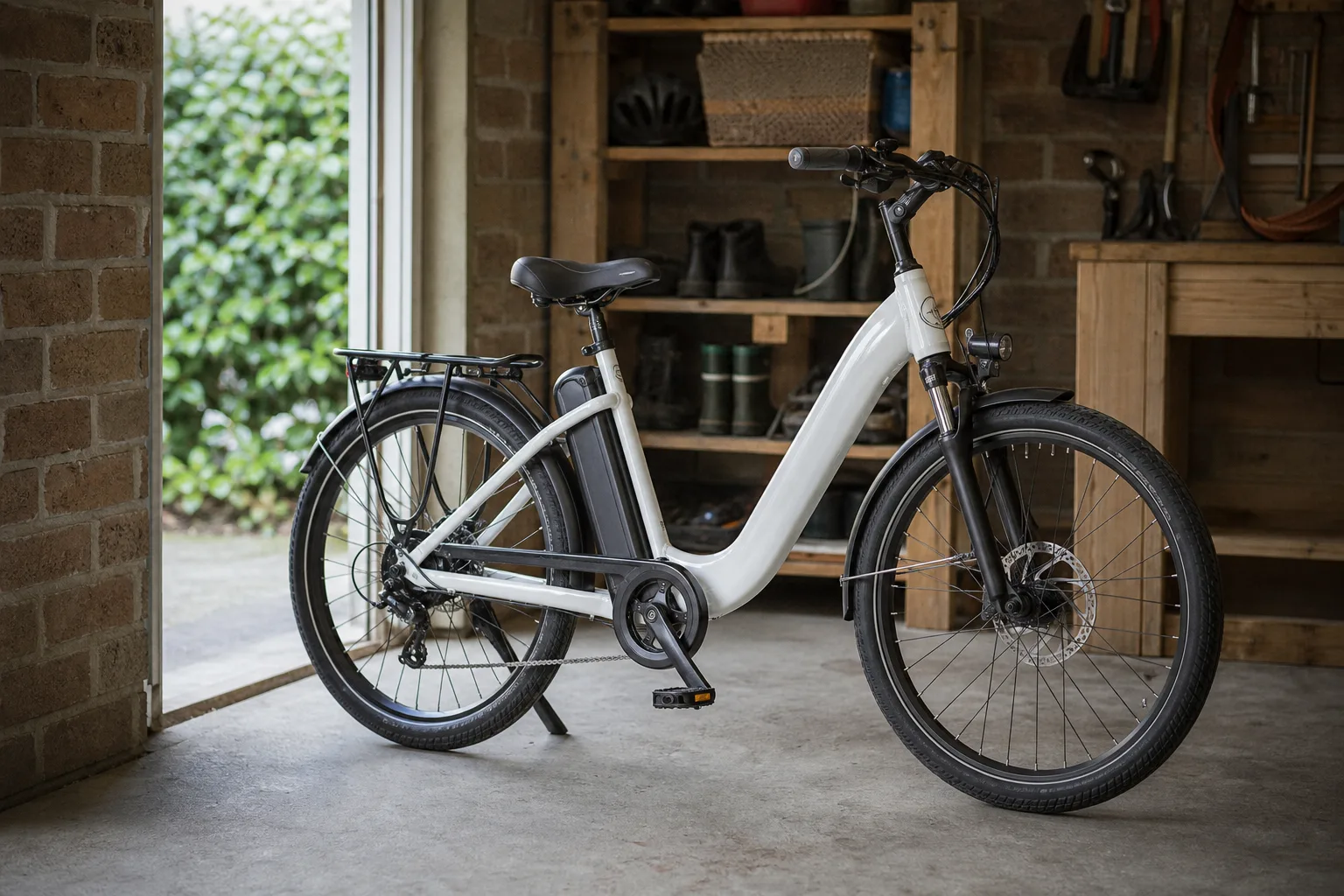
A shop in a converted storefront put a step-through e-bike on the shipping scale at the request of a customer who lived on the second floor of a walk-up, and the readout said sixty-two pounds with the battery in the frame, fifty-four with it out and sitting on the counter. She had asked because the listing said the bike weighed about twenty-eight kilograms, which meant nothing to her until it was standing next to a set of five stairs she climbed twice a day. The number is not the problem. The number distributed across five separate lifts, each with its own geometry, is the problem, and each of those lifts responds differently to taking eight pounds out of the down tube.
1. The curb, which is not a lift at all
Getting a front wheel up a six-inch curb is a tilt, and the load on the hands is a fraction of the bike's weight because the rear tire stays planted and does the pivoting. A rider with a stiff hip who cannot bunny-hop still manages this by pushing down on the bars and rolling forward, and sixty-two pounds behaves almost exactly like forty-eight pounds in that motion. What changes is the recovery: if the front wheel catches the lip and stops, the bike wants to come back at you, and a heavier bike arrives with more authority. A careful reader tests this on the sidewalk outside the shop, not in the aisle.
2. The hallway step, where the missing top tube shows up
Two or three steps into a vestibule are carried, not rolled, and this is where step-through frames make their own demand: there is no top tube to hook over a shoulder, so the bike has to be lifted by the seat tube, by the down tube behind the head tube, or by saddle and stem together. Two-handed lifting by saddle and stem is the honest test, because it is what most people do, and it is where fifty-four pounds and sixty-two pounds stop feeling similar. Pulling the battery before the stairs and carrying it separately turns one hard trip into two easy ones, which is usually the right trade.
3. The hitch rack, and the number printed on the tray
Platform hitch racks carry the bike by its wheels, which suits a step-through, but every rack has a stated per-bike weight limit, and plenty of them sit below what a loaded e-bike weighs with rack, fenders, lock and a full battery. The lift is short, roughly to knee or mid-thigh, but it is a lift out in front of the body with no wall to brace against. Check three things before buying: the per-bike capacity, the tray channel width against the tire, and whether the arm clamps a frame tube you actually have. The Consumer Product Safety Commission oversees bicycle equipment standards, and rack capacities are published for a reason.
4. The bike-room ramp, which walk-assist solves outright
A basement bike room reached by a ramp is the one place where weight almost stops mattering, provided the bike has walk-assist that engages reliably from a standstill on a grade. Walk-assist runs the motor at a slow pace, typically under four miles an hour, while the rider stands beside the bike steering, and it will push sixty-two pounds up a slope that would otherwise mean leaning into the saddle with a bad knee. The check is specific: hold the brake, engage walk-assist on an incline, and confirm it restarts under load rather than only on the flat.
5. The lift you did not plan for
Every bike eventually gets picked up sideways to clear a bollard, hoisted onto a repair stand, or lifted out of a wheel rut, and those are the moments that decide whether a rider keeps riding. Weigh the bike as you will actually own it, with the rear rack, the lock, the fenders and the battery, and then weigh it again with the battery out so you know the real spread. A frame handle, or a clean gap at the seat tube where a hand fits, is worth more than four pounds of catalog difference.
The useful habit is to count the lifts in one ordinary day, put a height and a hand position on each, and then ask which of them the battery latch can remove from the list entirely.