What bracing weighs
A properly braced open frame usually runs a pound or two heavier than the diamond frame beside it. That weight is paid on stairs and car racks, not on the road.
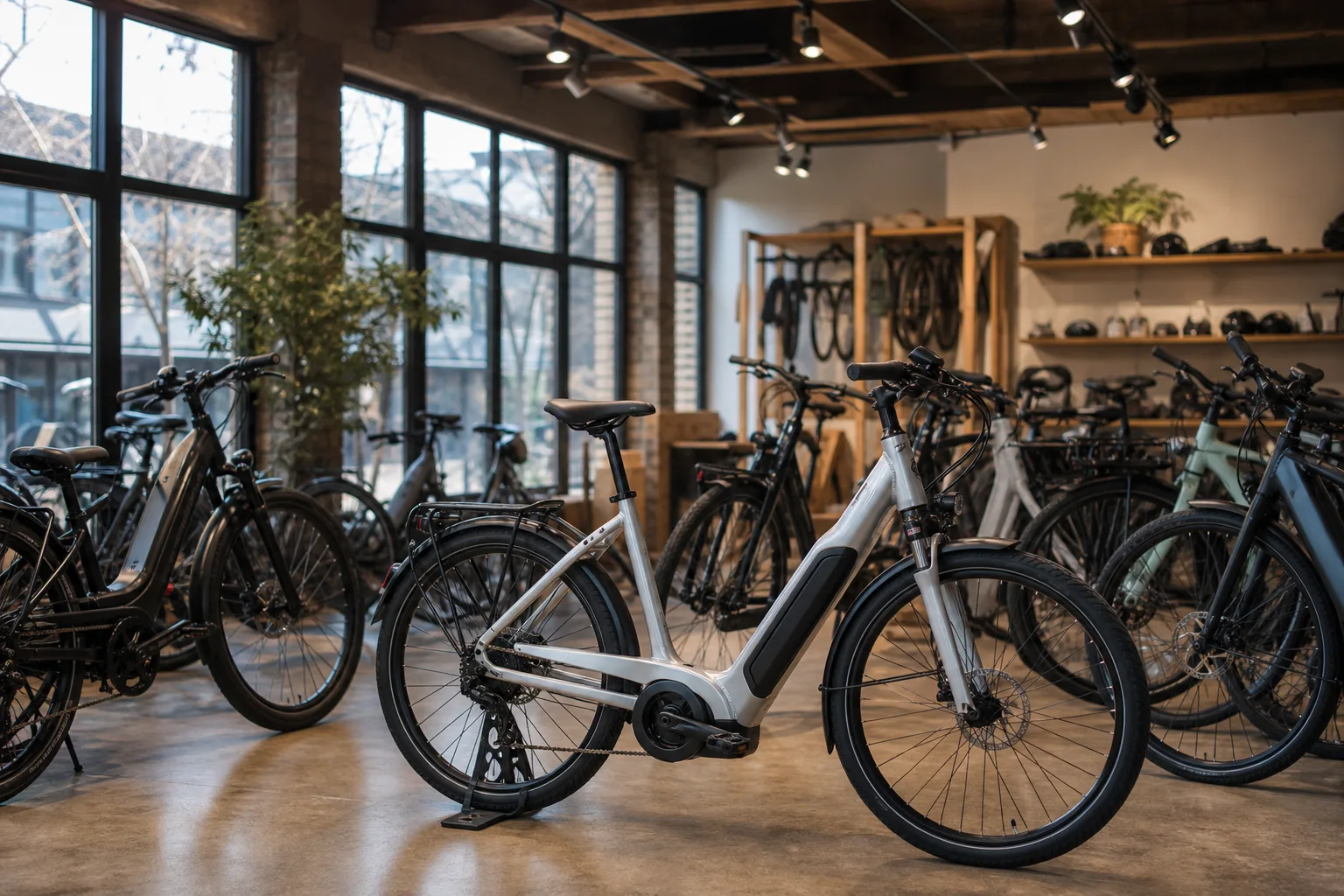
A properly braced open frame usually runs a pound or two heavier than the diamond frame beside it. That weight is paid on stairs and car racks, not on the road.
Hold the front brake, lean on the bars, and watch whether movement stops or keeps going. A frame that springs back cleanly without shuddering is doing its job.
Weight ahead of the steering axis is the load most likely to make an open frame feel vague. A rear rack mounted to the seat stays carries the same groceries with less effect.
Two bikes on adjacent stands at a shop in a strip mall, both with 26-inch wheels, both with rear hub motors, both sold to the same kind of buyer. One has a conventional diamond frame with a top tube running from the head tube back to the seat. The other has nothing in that space at all, just a long curved beam sweeping from the head tube down to the bottom bracket. Grab the front brake on the second bike, plant a foot on the pedal, and push the bars forward. Something moves. It is small, maybe a quarter inch at the stem, but it is there.
That movement is the whole subject. A diamond frame is a pair of triangles, and a triangle cannot change shape without one of its sides changing length, which steel and aluminum tubes refuse to do at the loads a bicycle sees. Remove the top tube and the front triangle becomes a three-sided open shape with a hinge at each corner, so the head tube can rotate slightly relative to the seat tube under a hard shove. The frame is not weak. It is less rigid, which is a different property, and the difference is measured in fractions of a degree.
Nobody sells an unbraced open frame. The standard answer is a downtube two or three times the cross-section of the one on the diamond bike, often hydroformed into an oval or a teardrop so it resists twisting as well as bending. Twin tubes are the other common approach, two smaller parallel members running side by side from the head tube to the rear dropouts, which is where the classic mixte layout came from and why it survived. Add gussets at the head tube, a heavier bottom bracket shell, sometimes a brace between the seat tube and the rear stays.
All of that is material, and material weighs something. A well-braced open aluminum frame typically runs a pound or two heavier than the diamond frame it sits beside, and on an electric model the battery mount and motor torque plate add more. This is the first real cost of the decision, and it is not paid on the road. It is paid on the stairs, in the car rack, at the bike rack on the bus. A rider who cannot swing a leg over a top tube often cannot lift ninety pounds either, and the two constraints have to be solved together.
Honestly, mostly not. Frame flex announces itself in a narrow set of conditions: standing and sprinting out of the saddle, cornering hard at speed with body weight thrown against the pedals, descending long grades fast enough that a small oscillation can build into a wobble. Errands at twelve miles an hour on level pavement produce none of those. The rider who goes six blocks to the pharmacy, sits down the whole way, and stops at four intersections is loading the frame in exactly the direction it is stiffest, which is straight down through the seat tube.
Where an open frame will speak up is under load, and the loads that matter on an errand bike are front baskets and rear panniers. Ten pounds of groceries in a handlebar basket sits ahead of the steering axis, and on a frame with a softer front end that mass can make the steering feel slightly delayed, a beat behind your hands, especially on a bike with a long wheelbase. A rack mounted to the seat stays behaves better than a basket clamped to the bars, and that is a purchasing decision, not a frame limitation.
A hub motor pushes the frame from one end rather than through the crank, and a mid-drive puts real torque into the bottom bracket shell, which is precisely the corner an open frame has the least structure to defend. Manufacturers who take this seriously oversize the shell area, run the downtube into it at a wider junction, and specify a torque arm at the rear axle. Something like the sixthreezero step thru electric bike shows the pattern clearly, with a deep single downtube doing the structural work the missing top tube used to do. The Consumer Product Safety Commission oversees the federal requirements bicycles sold in the United States have to meet, and frame construction falls within that remit.
The practical test in the shop takes thirty seconds. Squeeze the front brake, lean on the bars, and watch the gap between the front tire and the downtube. Then sit on the saddle, have someone hold the rear wheel, and try to twist the bars against it. You are not looking for zero movement, because you will not find it. You are looking for movement that stops rather than movement that keeps going, and for a frame that returns to where it started without a shudder.
The dropped top tube costs you a pound or two of frame, some fraction of a percent of pedaling efficiency you will never measure, and a slightly less crisp feel with a loaded front basket. It buys you the ability to mount the bike without abducting your hip past forty degrees, which for a rider with a replaced knee or a stiff hip is not a preference but the difference between riding and not riding. Priced honestly, that is a bargain, and the manufacturers who brace the frame properly have already absorbed most of the engineering side of it.
What is worth spending attention on, rather than worry, is where the remaining weight goes and how you will handle it off the bike. Ask the shop for the actual weight with battery, not the frame-only number in the catalog, and lift the thing yourself before you sign.